Experimenting with music
Creating Piece 1
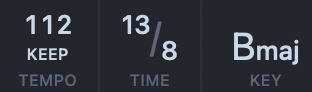


The first composition completed was aimed at providing an introduction for a play/film/series etc. with the use of an ongoing theme of ‘stuck’ and never-ending loops. It did so by drawing from multiple sources and genres from global contexts and personal cultural references. I used the single note of B as a pedal note throughout the whole piece in sections labelled rep. B0, and used multiple octaves of B (rep. B0+1+2) to slowly ease into the piece and provide structure throughout. This is inspired by the introduction of Hollow Talk – a song by the Choir of Young Believers, based in Denmark, my nationality – as they use a repetitive single-note rhythm to bring in the piece. ‘Hollow talk’ was similarly used as the intro in the Scandinavian TV series Bron/Broen (The Bridge) and branches from a huge part of Danish culture of Scandi-noir atmospheric mood, consisting of dark, moody and dramatic crime fiction.
This pedal note and repeating B overall also creates a simple base that allows the more complex rhythms within B note sections, the chromaticism of the call and response section, the dissonance in the Badd9 at bar 14 and the almost awkward 13/8 time in place. This allows for a contrast between the sparse texture at the first and last two bars with the dense, convoluted and intricate patterns that emerge between. This draws inspiration from Thom York’s composition “Dawn Chorus”, which uses simple repetitive rhythmic patterns, as I do with repetitive syncopation between B1+B2 parts at bars 9-12, and which has a rit. sometimes at the end of bars, pulling the piece and pushing it to the next bar almost as a form of rubato which sounds like an extra quaver. This makes the piece feel like 13/8, despite not perhaps intending it. I implicated this in my piece by using 13/8 time, transforming that idea of push-pull to give the effect of a never-ending loop.
Creating Piece 2




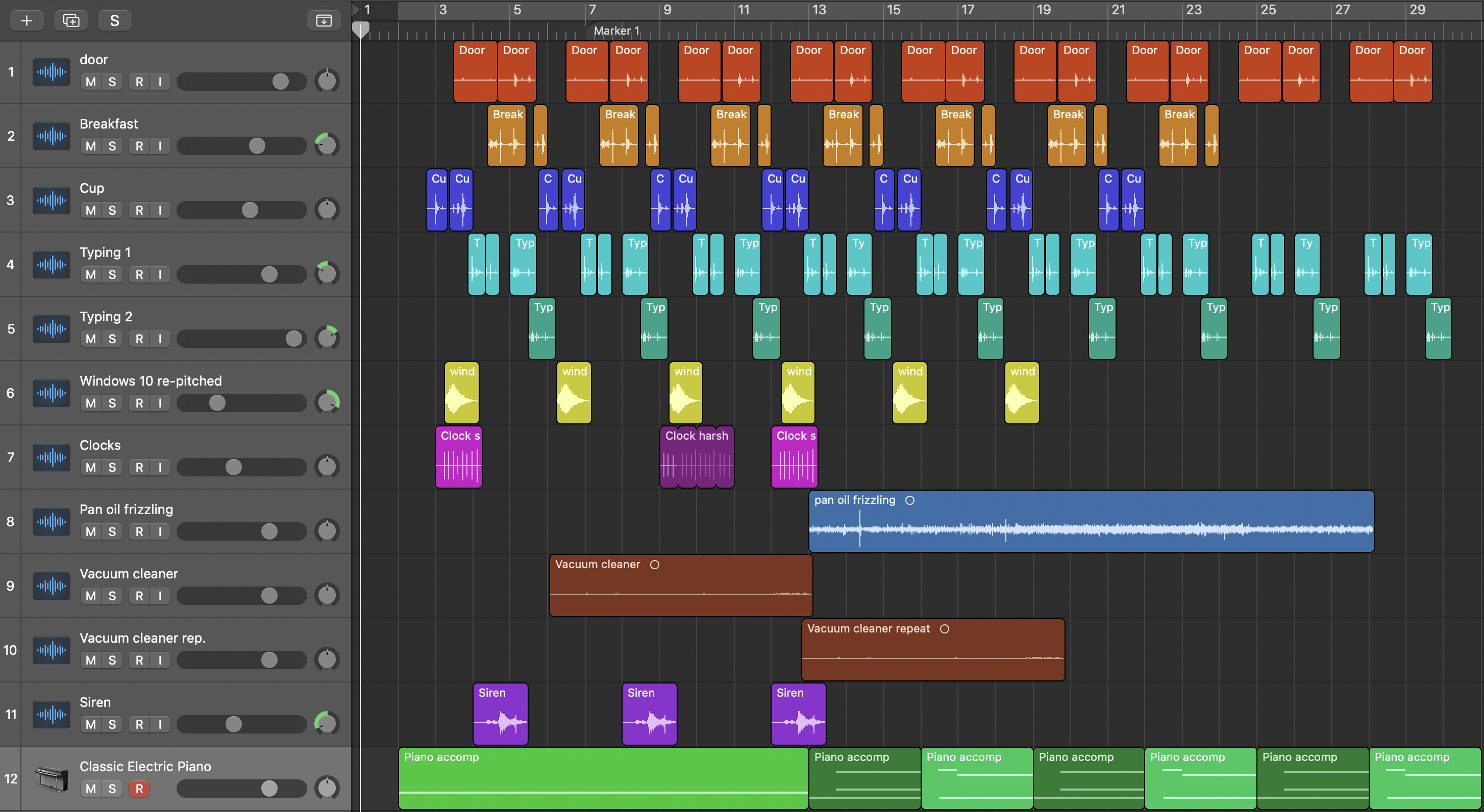
This second composition is an exploration into the use of sampling, electronic manipulation of rhythm, and again the of loops. Based around the theme of ‘stuck’, it takes inspiration from the use of rhythmic sampling in Pink Floyd’s “Several Species Of Furry Animals Gathered Together In A Cave And Grooving With A Pict”, in addition to the ambient, experimental and electronic works of Brian Eno (e.g. in his collaboration with David Byrne, 1981’s My Life in the Bush of Ghosts) This style, known as found object sampling (widely known as objet trouvé in French), is the incorporation of everyday objects or sounds into music.
This piece is centred around a D pedal note sustained throughout the 1-minute work, making the key of the piece D minor. It has a tempo of 120 and a metre of 4/4, making the beats double as fast as seconds, which initiates a feeling of franticness and embodies the atmosphere of a busy life to the listener. The chord progression that arises from bar 13 -> end of Dm6, Csus2, G serves to replicate the ‘rise and falls’ and the ‘problem and solutions’ of life, starting minor (the problem), ending major (the solution), with the Csus2 chord allowing smooth transition between them.
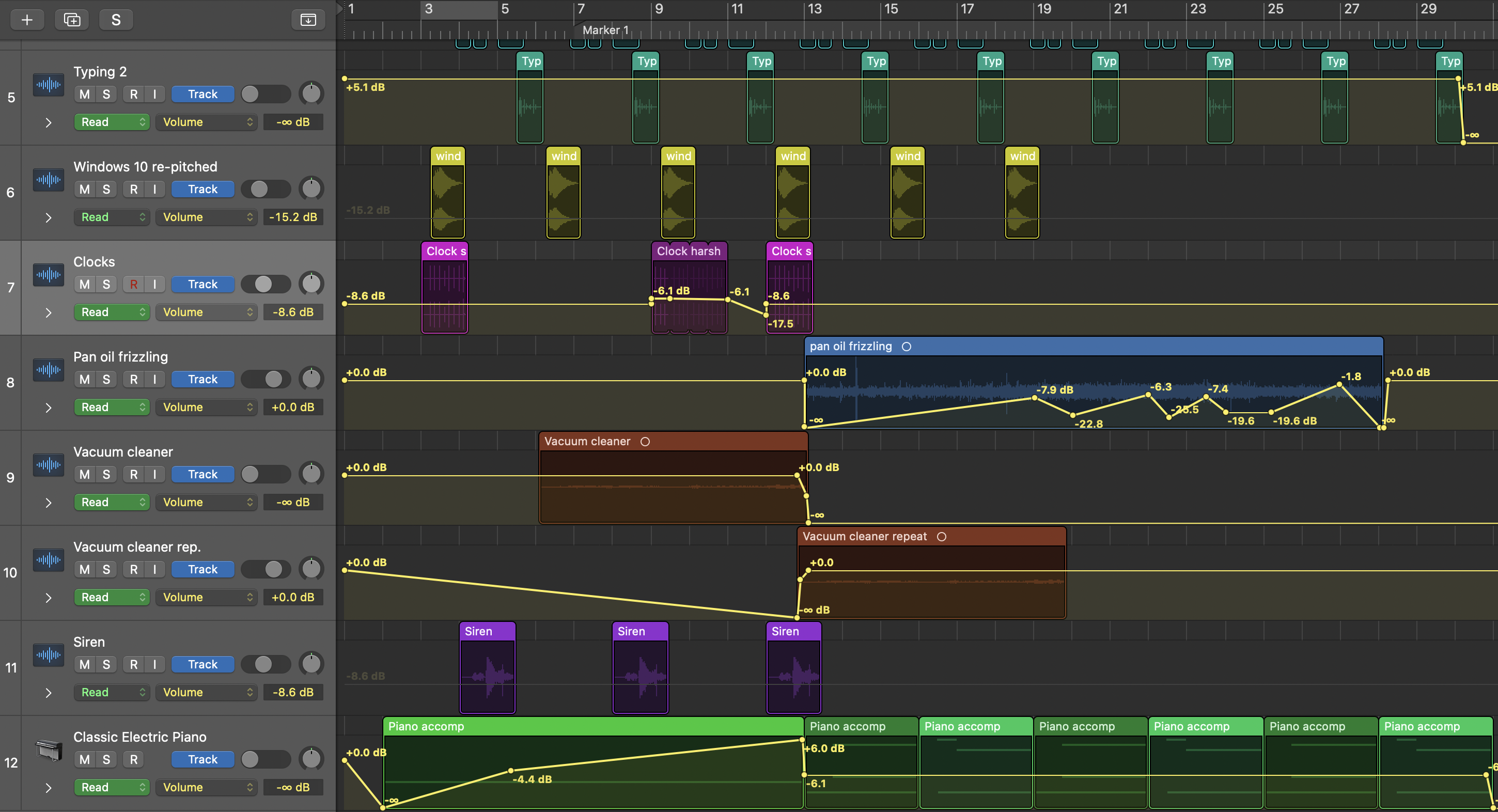
The use of everyday sounds in samples is effective at accomplishing the theme of ‘stuck’, as incorporating elements of life into music creates repetition and the feeling of a boring life of a 9-5 job, a dying career, a loveless home etc. For example, the use of a clock (ticking twice every second, bars 3,9+12) and the use of typing (see ‘typing 1+2’) establish a rhythmic base upon which everything is built and layered. Then the use of a vacuum cleaner (bar 6-20) and a frying pan sizzling (bars 13-28) with panning overall, (e.g. with the vacuum cleaner panning across gradually, replicating the actions of a vacuum cleaner in real life, see above) creates an atmospheric and denser texture to the piece, making it more invigorating to the listener and linking it further to ‘stuck’.
Creating Piece 3
In the third composition played above, I chose to try the unfamiliar and daunting polymetre. In addition, I incorporated elements of minimalist music, modern contemporary music and impressionist classical music. With this, the purposes of the piece were music for listening and performances as well as to demonstrate music technology in the electronic and digital age.
The extensive use of polymetres, such as in this piece, would be virtually impossible to conduct, construct or play in the case of a live orchestra in one room, and so for that purpose, the use of digital technology is really innovative in allowing such music to be created still with orchestral instruments. So, to best imitate a real orchestra within a computer-based system, I utilised panning to mimic the live-performance staging of instruments within a room.
To do this, I set up everything through logic pro on a 12/8 system, despite having different loops with different metres within most instruments (e.g. 13/8, 7/8, 3/8). This meant that occasionally the different polymetres would align, so for a dramatic effect, the whole piece was designed in a way so that all the metres aligned after the last chord. This polymetre proved challenging as I had to ensure that the polymetre would be emphasised in such a way that the piece didn’t seem like a free-tempo or a piece with just different rhythm lines over the same metre. To combat this, I used pitched percussive instrumentation to bring in the rest of the orchestra and end the piece, ensuring that the polymetre was established from the start and consolidated in the end.
At the start of the piece, it follows a very minimalist structure of ongoing rhythms and pitches with occasional changes (bars 1-12), inspired by John Adams’ use of rhythm-grounded repetitive and shifting chords in his piece “Short ride in a fast machine”. Then, it switches into a seemingly smooth chord progression, mainly heard by the orchestral instruments. During this, the piece switches from a harmony of consonance to a harmony of dissonance through the addition of a B to the e flat by strings in bar 23 to directly clash and create uneasiness, introducing it to the ethereal-like third section (bar 25-end) in which, as seen in many pieces by impressionist Claude Debussy, I incorporated a chromatic piccolo melody line that pleasingly clashed its tonal centre of F with the ongoing B major chord.
Performing Piece 1
Beatles – Norwegian Wood (Heavily adapted)
adaptation poetry that contrasts in tone and meaning with the theme, style and meaning of the original lyrics.
Performing Piece 2
Marvin Gaye – What’s Going On?
An attempt of exploring lyrical meaning without aesthetic intent. Can lyrics in a piece of vocal music stand on their own without the singer doing what they would normally be doing with expressive touches and vocal technique?
Performing Piece 3
Billie Holiday – Strange Fruit (lyricless)
A test of whether lyrics are entirely necessary to get expressive intent towards the listener. Does the absence of lyrics remove the meaning of a piece? Can it remove the sense of protest